

Apr 22, 2026 Tyrone Castelanelli
ShareFraud prevention has long been designed around the operational perimeter of a single institution. That model is now under pressure. In 2024, the European Banking Authority (EBA) and the European Central Bank (ECB) reported payment fraud losses of €4.2 billion across the EEA. Separately, the EBA 2024/25 Consumer Trends Report identified payment fraud - particularly social-engineering scams - as the most significant issue affecting EU consumers.
At the same time, Europe's payments environment is becoming faster and more interconnected. The Instant Payments Regulation has introduced major milestones for instant payments and Verification of Payee (VoP), requiring fraud teams to make faster, more confident decisions. Taken together, these changes raise a broader question: is internal monitoring still enough when the signals that matter increasingly sit beyond a single institution's own perimeter?
Fraud No Longer Fits Inside a Single Institution
For years, banks have invested heavily in fraud controls. Transaction monitoring, behavioral analytics, machine learning, and layered authentication remain essential parts of a modern defense strategy. And they work: the EBA and ECB confirm that strong customer authentication is still effective against the fraud types it was originally designed to mitigate, especially for card payments.
But fraud patterns have evolved. Newer scam types increasingly rely on manipulating legitimate payers into authorizing fraudulent transactions, also known as authorized push payment (APP) fraud. That changes the nature of the challenge. The issue is no longer only whether a bank can detect unauthorized behavior inside its own systems. The challenge increasingly centers on whether institutions can recognize a broader fraud context quickly enough to act before the payment is processed.
Strong Analytics Still Leave a Visibility Gap
This is not an argument against internal analytics. On the contrary, internal fraud systems remain the operational core of prevention. They know the customer relationship, the historical behavior, the channel context, and the institution's own risk appetite. None of that becomes less important in a more connected payments market.
What does change is the limit of what even strong internal models can see. A transaction may appear normal when evaluated against one institution's own data, while presenting clear fraud indicators when viewed in a broader network context. That is the real pressure point for many institutions today: not a lack of analytics, but a lack of visibility beyond their own boundaries. In a market shaped by faster payments and more adaptive fraud patterns, that gap matters more than ever.
Instant Payments Are Raising the Pressure
The Instant Payments Regulation has made this shift even more urgent. Financial institutions and PSPs in euro area member states have had to be ready to receive instant payments from 9 January 2025 and to send them from 9 October 2025. With payments moving in real time, the window for fraud assessment becomes dramatically smaller.
This creates a new reality for fraud teams. They are not simply being asked to detect more. They are being asked to decide faster. In an instant payments environment, there is far less room for hesitation, manual review, or incomplete context. Institutions need fraud prevention approaches that support confident, real-time decisioning without creating unnecessary customer friction, combining internal intelligence with external context.
FPAD Shows Where the Market Is Heading
This is where network intelligence is moving from concept to operational reality. A strong example is EBA Clearing's Fraud Pattern and Anomaly Detection service, FPAD. EBA Clearing describes FPAD as a fraud-fighting functionality for STEP2-T and RT1 participants that offers real-time fraud prevention and detection tools, supports fraud prevention during payment initiation, as well as fraud detection after settlement.
In practice, that means participating institutions can draw on signals derived from activity patterns across the wider network, rather than relying only on what is visible within their own environment. A transaction that appears only moderately risky internally may warrant closer attention when assessed in a broader context. This added perspective helps institutions make more confident decisions, particularly where speed and limited visibility make fraud assessment more difficult.
Strategically, FPAD is important not only because it adds another control layer, but because it reflects the direction of travel in the payments ecosystem. Fraud prevention is becoming more collaborative, more network-aware, and more dependent on timely external context. Instead of evaluating a payment solely against one institution's own history, network intelligence makes it possible to add signals derived from a wider ecosystem view. That gives institutions a stronger basis for both prevention and investigation.
This is also where INFORM's role becomes relevant. In our FPAD-readiness announcement, we confirm that our comprehensive financial crime and risk management solution, RiskShield, fully integrates FPAD risk indicators and IBAN/Name check results into its decision logic in real time. External intelligence does not sit beside fraud operations as a disconnected feed. It becomes part of a unified decisioning environment, helping institutions combine internal analysis with network-level context, with people in the loop.
The Future of Fraud Prevention Is Collaborative
The broader direction is becoming clear. Europe is moving toward faster payments, stronger transaction assurance, and more structured forms of fraud-related collaboration. Services like FPAD are part of that development because they help close a structural gap that internal-only monitoring cannot fully address on its own.
Institutions that succeed in this environment will be those that strengthen their internal fraud analytics with trusted external intelligence and translate both into operational action at speed. The next phase of fraud prevention will be defined by how effectively institutions connect visibility, context, and decisioning across a wider payments ecosystem, with human expertise guiding the final call.
Fraudsters already exploit the spaces between institutions. The response is to narrow those spaces with better visibility, better context, and faster, more confident decisions. That is the shift behind network intelligence, and one of the clearest reasons this topic is moving up the agenda now.
Applying Network Intelligence in Practice
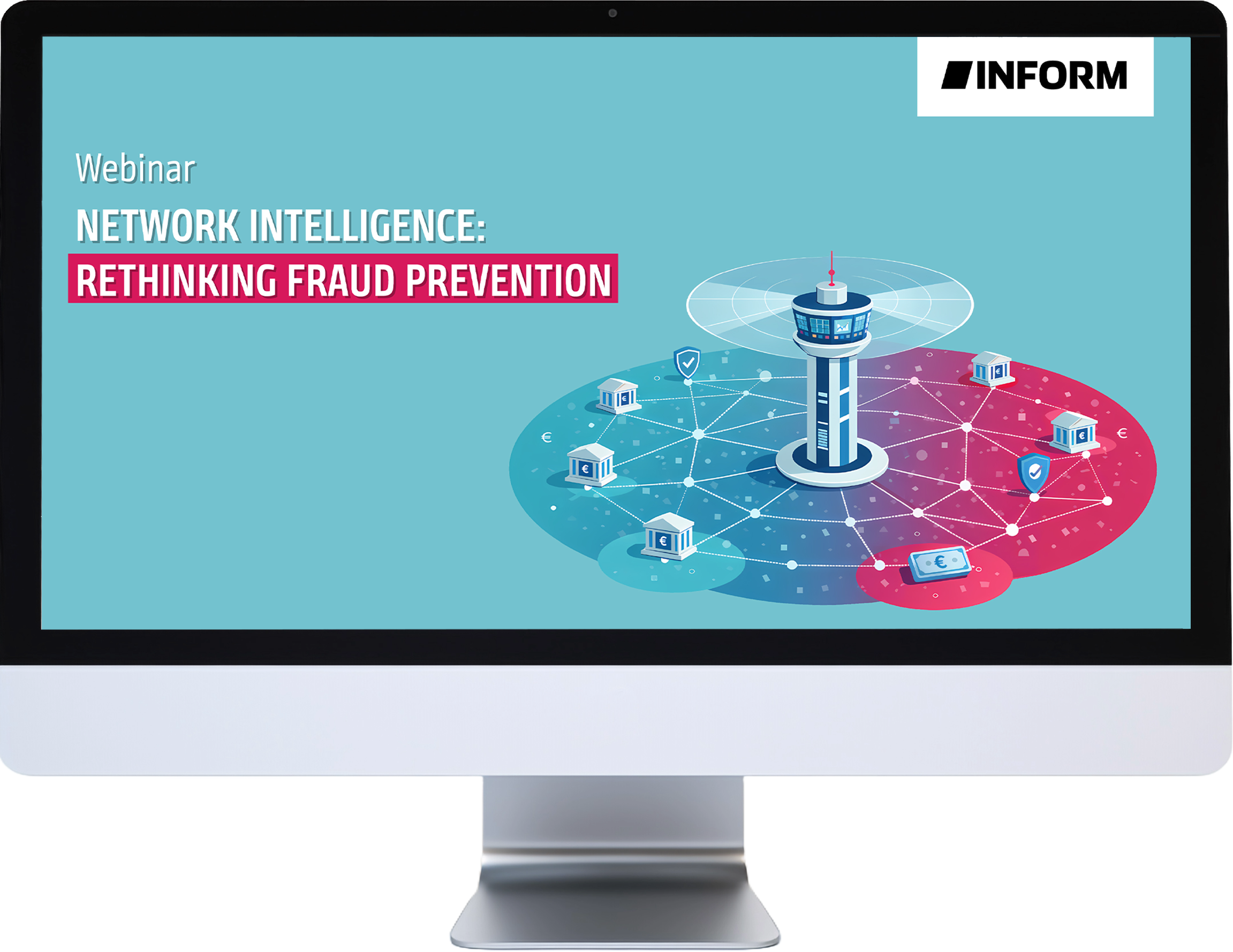
These developments are already being addressed at industry level. In our expert webinar with EBA Clearing and CREDEM, we discuss how financial institutions apply network intelligence to close cross-bank visibility gaps and support real-time fraud decisioning.
About our Expert

Tyrone Castelanelli
Senior MarComms Manager | Risk & Fraud
Tyrone Castelanelli has been with INFORM since April 2022, and is part of the marketing team at the Risk & Fraud division. Tyrone has specialized in marketing communications, with experience of over 18 years in three tech companies.
 All Posts