


SHARED CUSTOMER CONTEXT
Information from different application areas can be combined to create a broader view of customer activity and financial crime risk.
Fraud and money laundering are closely connected. Fraudulent proceeds need to be moved and concealed, while money-laundering schemes may involve stolen identities, synthetic accounts, account takeover, or money-mule networks.
Yet many financial institutions still manage fraud and AML through separate teams, systems, and data sources. This can make connected activity harder to identify and investigations more difficult to coordinate.
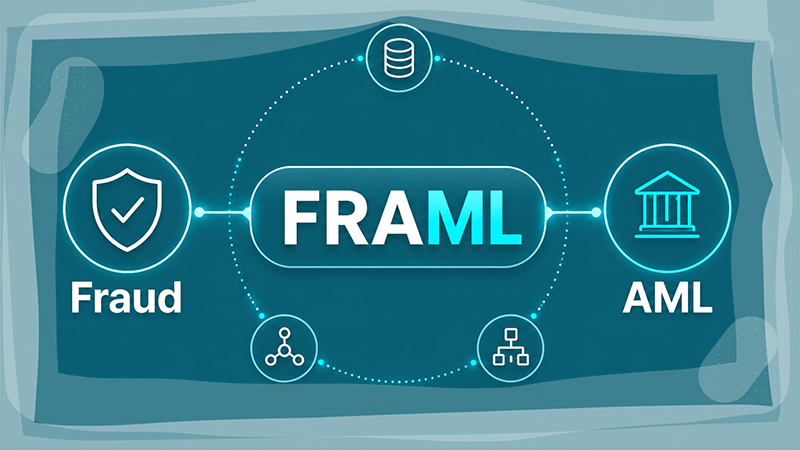
The term FRAML combines “fraud” and “AML” (Anti-Money Laundering). It describes closer coordination of both disciplines through shared data, technology, intelligence, and workflows.
FRAML does not make fraud prevention and AML identical. Instead, it strengthens coordination where their responsibilities and information overlap.
FRAML can improve how financial institutions detect, investigate, and manage financial crime. Its effectiveness depends on clear governance, reliable data, and sufficient operational flexibility.
Clear governance
Responsibilities, decision rights, and escalation paths must remain clear despite different mandates, timelines, and performance priorities.
Reliable data integration
A broader customer view depends on accurate, relevant, and timely information from different systems and application areas.
Operational flexibility
Institutions need to retain control over rules, models, workflows, and monitoring scenarios as risks and regulatory requirements evolve.
FRAML requires technology that can combine relevant information, assess risk in real time, support specialist workflows, and make decisions understandable and adaptable.
Meeting these requirements calls for a platform that connects fraud and AML capabilities while preserving operational flexibility.
RiskShield brings relevant fraud and AML capabilities together in a common technological environment. It supports shared customer context, real-time risk assessment, specialist workflows, and transparent, configurable decision-making. Institutions can adapt detection scenarios, rules, workflows, and operational priorities to their own requirements.
RiskShield supports use cases including:
Every institution approaches FRAML from a different starting point. Talk to our experts about where closer coordination between fraud and AML could create value for your organization.

Dr. Stephan Lemkens
Solution Owner Compliance | Risk & Fraud
Stephan has been a consultant within the Professional Services Team since 2018, gaining experiences with projects focusing on Transaction and Session Monitoring in the context of fraud prevention. Since 2020 he has been focusing on Compliance, working closely with our customers on projects around Suspicious Activity Monitoring and Customer Due Diligence.


